The fastest semi truck in the world isn’t crawling through traffic at highway speeds—it’s blazing past sports cars at a mind-boggling 171 mph. That’s the reality of the Volvo Iron Knight, which claimed world records in 2016 for both the standing 500-meter and 1000-meter categories.
What makes the fastest semi in the world so extraordinary? For starters, the Iron Knight accelerates from zero to 62 mph in just 4.6 seconds. Additionally, this fast semi truck packs a monstrous 12.8-liter inline-six turbo-diesel engine generating 2,400 horsepower and 4,425 lb-ft of torque[-2]. When tested on a closed Swedish track, it hit 81.58 mph in just 500 meters and reached 105 mph over 1,000 meters in a mere 2.29 seconds.
However, the Volvo Iron Knight isn’t the only speed demon on our list. This article explores the 11 fastest semi trucks breaking speed records in 2025, examining their specifications, design innovations, and the technology that allows these massive machines to achieve such remarkable performance.
Volvo Iron Knight
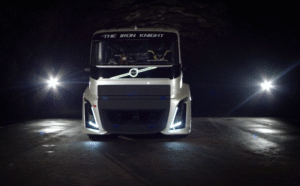
Image Source: The Fast Lane Truck
Aptly named “The Iron Knight,” Volvo’s record-shattering truck stands as a testament to engineering excellence in the world of heavy-duty vehicles. This custom-built machine represents the pinnacle of semi truck performance, pushing boundaries that most commercial vehicles could never approach.
Top Speed of Volvo Iron Knight
The Iron Knight achieved an extraordinary top speed of 276 km/h (171 mph) during its record-breaking runs. Beyond raw speed, this truck demonstrates remarkable acceleration, matching sports cars by reaching 100 km/h (62 mph) in merely 4.6 seconds. During official record attempts, the Iron Knight covered 500 meters at an average speed of 131.29 km/h in just 13.71 seconds. Furthermore, it conquered the 1000-meter distance at 169.09 km/h with a time of 21.29 seconds. Both performances shattered previous truck speed records, cementing its status as the fastest semi truck in the world.
Volvo Iron Knight Engine and Powertrain
At the heart of this speed demon lies a significantly modified mid-mounted D13 diesel engine equipped with four turbochargers and a water-cooled intercooler. This powerplant generates a staggering 2,400 horsepower and 6,000 Nm (4,425 lb-ft) of torque. Surprisingly, the Iron Knight utilizes the same I-Shift Dual Clutch transmission found in production Volvo FH trucks, albeit with reinforcements. The transmission’s ability to maintain torque delivery during gear changes proves essential for record-breaking acceleration. The disks and pressure plates in the clutch are made from sintered material to handle the enormous power.
Volvo Iron Knight Design and Aerodynamics
The Iron Knight’s design prioritizes both aerodynamic efficiency and esthetic appeal. Its fiberglass cab minimizes air resistance while maintaining visual links to Volvo’s commercial trucks. Large air ducts integrated into the side-skirts supply crucial cooling air to the high-performance engine. Weighing just 4,500 kg (4.5 metric tons), the Iron Knight is approximately 1,000 kg lighter than its predecessor. Engineers further reduced weight by minimizing electronic systems, focusing exclusively on essential components needed for record-breaking performance.
Volvo Iron Knight Use Cases or Racing History
The Iron Knight continues Volvo’s tradition of building record-breaking trucks, following the “Wild Viking” and “Mean Green”. Behind the wheel during its record runs was Boije Ovebrink, a veteran with more than 30 years of motorsport experience and a former European Truck Racing Champion. The record attempts took place at a closed airfield in northern Sweden, where the Iron Knight surpassed the previous records set by Volvo’s earlier speed demons. For comparison, the 2007 “Wild Viking” reached 158.8 km/h over 1000 meters, while the hybrid “Mean Green” achieved 152.2 km/h in 2011. The FIA International Motorsport Association reviewed and subsequently confirmed the Iron Knight’s record-breaking performances.
Volvo Mean Green

Image Source: For Construction Pros
Before the Iron Knight claimed its throne, Volvo’s Mean Green hybrid truck rewrote the record books as one of the fastest semi trucks ever built. This distinctive bright green machine represents a milestone in combining diesel and electric power for record-breaking performance.
Top Speed of Volvo Mean Green
Mean Green established impressive world speed records at Utah’s Wendover Airfield in April 2012. The truck reached a remarkable 236.577 km/h (147.002 mph) in the flying kilometer and 153.252 km/h (95.245 mph) in the standing kilometer. These official achievements surpassed Mean Green’s previous records set in Sweden in 2011, which stood at 218.780 km/h (135.943 mph) for the flying kilometer and 152.253 km/h (94.605 mph) for the standing kilometer. Notably, the truck had previously achieved unofficial speeds of approximately 164 mph during testing on a Swedish course.
Volvo Mean Green Engine and Powertrain
The power behind Mean Green comes from an innovative hybrid configuration. At its core sits a highly tuned Volvo D16 diesel engine paired with a modified version of Volvo’s I-Shift automated transmission. The diesel component alone delivers 1,900 horsepower, but what makes this fast semi truck truly special is its electric motor, which contributes an additional 200 horsepower and 885 lb-ft of torque. Together, the combined system generates approximately 2,100 horsepower and nearly 5,000 lb-ft of torque. This hybrid setup provides instant acceleration without the typical diesel-engine delay—essentially functioning like “a champagne cork” from standstill.
Volvo Mean Green Design and Aerodynamics
In contrast to conventional trucks, Mean Green features a dramatically modified aerodynamic body designed specifically for high-speed runs. Despite its radical appearance, the truck utilizes a North American Volvo VN cab and frame alongside other production components. Designer Jonas Sandström at Volvo created the optimal aerodynamic shape using CAD programs, emphasizing that unlike Formula 1 cars that use downforce, this fastest semi truck was designed to “slice through the air”. Weight reduction proved crucial—the front axle was milled down from 100 kg to 57 kg, unnecessary gear sets were removed, and even wiring harnesses were modified to eliminate excess weight.
Volvo Mean Green Use Cases or Racing History
Behind the wheel of this record-breaking machine was Boije Ovebrink, Mean Green’s owner and driver, who also set previous truck speed records with Volvo vehicles. The April 2012 record attempts faced challenges due to Wendover Airfield’s 4,200-foot elevation, which required the team to reduce the truck’s power by nearly 20% to prevent overheating in the thinner air. The United States Auto Club sanctioned the records, which were later verified by the Fédération Internationale de l’Automobile (FIA). Beyond setting records, Mean Green served as a technology demonstrator highlighting the potential of hybrid powertrains in commercial applications.
Tesla Semi
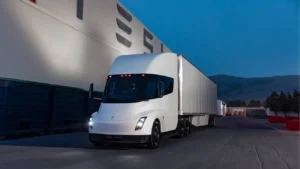
Image Source: Top Speed
The electric revolution meets raw power in Tesla’s Semi, bringing battery-electric performance to the world of heavy-duty trucking. Elon Musk’s foray into commercial transport challenges conventional notions of what a fast semi truck can accomplish without relying on diesel engines.
Top Speed of Tesla Semi
Though not designed primarily for speed records, the Tesla Semi delivers remarkable acceleration for a vehicle of its class. When unloaded, this electric behemoth accelerates from 0 to 60 mph in a mere five seconds—matching many passenger cars. Moreover, even when fully loaded to 82,000 lbs (37,195 kg), it reaches 60 mph in just 20 seconds. On steep grades, the Tesla Semi maintains highway speeds where diesel trucks struggle; it can climb a 5% grade at highway speed limit and easily passes other trucks when driving uphill on a 6% incline.
Tesla Semi Engine and Powertrain
At the heart of this fast semi truck lies an innovative tri-motor system featuring carbon-sleeved rotors—the same technology found in Tesla’s Model S Plaid. The first rear axle has one electric motor constantly engaged through a single-speed reduction gear, optimized for highway driving. Simultaneously, the other two motors power the left and right wheels of the rear axle, automatically engaging or disengaging based on speed and acceleration needs. This configuration delivers approximately three times the power of a conventional diesel semi. Energy consumption remains impressively low at less than 2 kWh per mile, with real-world testing by DHL confirming an efficiency of 1.72 kWh per mile when operating at speeds exceeding 50 mph.
Tesla Semi Design and Aerodynamics
Unlike conventional trucks designed “like a barn wall,” the Tesla Semi is aerodynamically shaped “like a bullet”. Consequently, it achieves a remarkable drag coefficient of 0.36—more aerodynamic than even the Bugatti Chiron hypercar’s 0.38. Key design elements include aerodynamic side-flaps, low ground-clearance, a sharp elongated bumper, and a flat frame allowing smooth airflow. The driver sits centered in the cab with touchscreen displays positioned on both sides of the steering wheel.
Tesla Semi Use Cases or Racing History
PepsiCo stands as the Semi’s first major customer, with 21 trucks operating at their Sacramento facility. These vehicles handle both short-range deliveries under 75 miles and long-haul routes between 250-520 miles. According to Run on Less program data, three Semis completed 19,122 miles of slip-seated long-haul transport routes, with some units covering up to 800 miles in a single day (including charging breaks). Charging infrastructure includes Tesla’s Megachargers capable of delivering around 750 kW of power—approximately three times the output of Supercharger V3 networks. These systems can charge the Semi from nearly empty to 70% in about 30 minutes.
Freightliner SuperTruck II
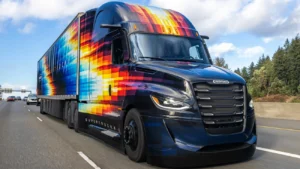
Image Source: Carscoops
While other trucks in our lineup chase top speed records, Daimler Truck North America’s Freightliner SuperTruck II redefines what makes a fast semi truck through unparalleled efficiency innovations. As part of the U.S. Department of Energy’s SuperTruck program, this concept vehicle demonstrates the future of freight transportation technology.
Top Speed of Freightliner SuperTruck II
Instead of traditional speed records, the SuperTruck II’s performance metric revolves around fuel efficiency. This remarkable machine achieves over 12 miles per gallon during real-world testing routes, doubling the freight efficiency of the 2009 baseline Freightliner Cascadia that managed only 6 MPG. For context, this improvement makes it one of the most technologically advanced diesel trucks ever created. At highway speeds, the engine operates at approximately 950 RPM versus the typical 1,100 RPM, allowing for quieter operation alongside improved efficiency.
Freightliner SuperTruck II Engine and Powertrain
The heart of this fast semi truck is a noncertified prototype Detroit 13-liter diesel engine featuring two-stage turbo and interstage cooling paired with a 13-speed overdrive transmission. This highly efficient powertrain enables a 5.7% fuel consumption reduction compared to the previous SuperTruck I. A revolutionary split cooling system consists of high-temperature and low-temperature cooling circuits working in tandem with two-stage turbocharging and exhaust gas recirculation cooling. Furthermore, a smart engine lubrication circuit minimizes internal pumping losses by actively proportioning flow to the most sensitive components.
Freightliner SuperTruck II Design and Aerodynamics
Aerodynamic efficiency stands as one of SuperTruck II’s most impressive achievements, with drag reduced by more than 12% over SuperTruck I. Rather than radically altering the truck’s structure, engineers redefined the existing Cascadia shape to maximize airflow efficiency. Key design elements include:
- Active side extenders and a roof spoiler system automatically closing the trailer gap to within 4 inches at highway speeds
- Enhanced Aerodynamic Height Control that lowers the truck inches from the ground for improved aerodynamics
- Replacement of bulky side mirrors with a Stoneridge mirrorless camera system
Freightliner SuperTruck II Use Cases or Racing History
Unlike traditional speed-record trucks, the SuperTruck II was developed primarily for real-world efficiency improvements. Four areas received particular attention throughout development: enhanced tractor aerodynamics, powertrain improvements, energy management, and low-rolling resistance tires. The truck features an innovative 48-volt electrical system with lithium-ion batteries enabling the intelligent EcoSail feature that automatically turns off the engine when drive power isn’t needed, such as during downhill descents. Particularly impressive is that this system powers steering even when the engine is off. DTNA partnered with Michelin to develop specialized tires for adaptive tandem axles, reducing energy consumption and maintenance downtime.
Kenworth T680 Next Gen
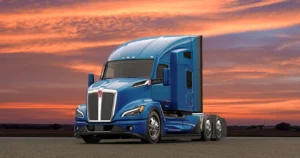
Image Source: Kenworth World’s Best Magazine
Kenworth raises the bar for practical performance with the T680 Next Gen, focusing on sustained efficiency rather than breaking track records. Unlike speed-obsessed rivals, this truck demonstrates how aerodynamic innovation translates to real-world advantage in the competitive hauling industry.
Top Speed of Kenworth T680 Next Gen
Although Kenworth doesn’t promote specific top speed figures for the T680 Next Gen, its performance benefits from advanced aerodynamics that optimize highway cruising. At highway speeds, the engine operates at approximately 950 RPM versus the typical 1,100 RPM, enabling smoother, quieter operation alongside improved efficiency. This reduction in engine stress allows for better sustained performance in everyday driving conditions without sacrificing capability.
Kenworth T680 Next Gen Engine and Powertrain
Powering this fast semi truck is the EPA 2021 PACCAR MX-13 engine generating between 405-510 horsepower and delivering 1,550-1,850 lb-ft of torque. For operators seeking alternatives, Kenworth offers the MX-11 engine option producing 355-445 horsepower with 1,250-1,700 lb-ft of torque. These powerplants pair with the PACCAR TX-12 automated transmission and PACCAR DX-40 tandem drive axles, creating an integrated powertrain optimized for efficiency. Additionally, the T680 Next Gen can be equipped with the Cummins Westport ISX12N near-zero emissions natural gas engine, rated at up to 400 hp and 1,450 lb-ft of torque.
Kenworth T680 Next Gen Design and Aerodynamics
Described as “the most aerodynamic truck in company history,” the T680 Next Gen offers up to 6% fuel efficiency improvement over its predecessor. Key aerodynamic innovations include:
- An 8-inch narrower hood and redesigned grille that cuts efficiently through air
- A-pillar turning vanes reducing wake next to side windows
- Side extenders extending an additional 9 inches (28 inches total) to close tractor/trailer gaps
- Unique ducting system with passive flaps that open and close based on air pressure
Kenworth T680 Next Gen Use Cases or Racing History
Ideal for line haul, pickup and delivery, and regional haul operations, the T680 Next Gen demonstrates its capabilities in actual commercial service. Crete Carrier incorporated 150 of these trucks into their fleet by the end of 2021. Driver assistance features include lane keeping assist technology that provides a “nudge” to correct direction when departing lanes. Furthermore, the cab includes a 15-inch digital display that allows drivers to customize their information display preferences for optimal operation.
Peterbilt 579EV
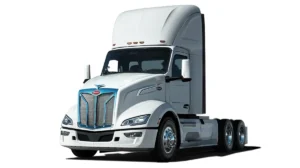
Image Source: Peterbilt
Shifting from diesel to pure electric power, the Peterbilt 579EV demonstrates that a fast semi truck doesn’t need combustion engines to deliver impressive results. This zero-emission Class 8 truck combines the reliability of Peterbilt’s popular 579 platform with cutting-edge electric technology.
Top Speed of Peterbilt 579EV
Unlike record-setting speed demons, the 579EV emphasizes efficiency over raw velocity. This electric hauler prioritizes practical performance with a range of up to 200 miles on a single charge, ideal for regional haul operations. With advanced regenerative braking, the truck recovers energy during frequent stops and starts, simultaneously extending range and reducing brake wear. Currently, the 579EV offers three distinct battery capacity options, allowing operators to balance range needs with payload requirements.
Peterbilt 579EV Engine and Powertrain
At the heart of this truck lies the PACCAR ePowertrain featuring a midship-mounted eMotor with dual electric motors. This innovative system delivers impressive performance—up to 605 horsepower and 1,850 lb-ft of torque, challenging conventional notions about electric truck capabilities. Uniquely, the 579EV employs a 3-speed transmission providing seamless shifting without torque interruption. Power flows to the wheels via a conventional driveline rather than an e-axle configuration, enabling compatibility with standard suspensions and axles across various wheelbase configurations.
Peterbilt 579EV Design and Aerodynamics
Visually, the 579EV distinguishes itself with exclusive styling elements—most notably blue accents on the crown and grille that signal its electric identity. The truck maintains the aerodynamic benefits of the diesel 579 while adding streamlined chassis fairings to enhance efficiency. Inside the cab, drivers interact with a 15-inch digital display featuring unique EV graphics showing essential performance metrics like range estimates, power regeneration, and efficiency insights.
Peterbilt 579EV Use Cases or Racing History
Primarily designed for regional haul and drayage applications, the 579EV excels in situations requiring frequent starts and stops that maximize regenerative braking benefits. Additionally, the truck supports PTO-powered trailer applications like transfer dumps and bulk haulers. Hunter Truck introduced the first two Peterbilt 579EVs to the Northeastern United States, supported by the New York Truck Voucher Incentive Program, which provided $300,000 toward their purchase. These deployments underline the truck’s role in improving air quality and reducing transportation emissions.
Nikola Tre BEV
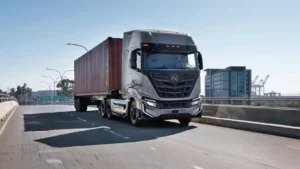
Image Source: Nikola Corporation
As a newcomer challenging established truck manufacturers, Nikola’s Tre BEV demonstrates how all-electric Class 8 semi trucks can deliver impressive performance without traditional diesel engines. This technologically advanced hauler combines cutting-edge battery technology with practical design elements for commercial applications.
Top Speed of Nikola Tre BEV
The Nikola Tre BEV achieves a maximum speed of 70 mph, making it suitable for highway operations alongside conventional trucks. During testing with a full 82,000-pound load, the truck demonstrated remarkable climbing ability, easily maintaining 55 mph on 5-6% grades. Even more impressive, the Tre BEV can accelerate from 0-60 mph in approximately 35 seconds when fully loaded—exceptional performance for a vehicle of this size and class.
Nikola Tre BEV Engine and Powertrain
Powering this fast semi truck is an advanced electric propulsion system featuring:
- Total battery capacity of 733-738 kWh across nine battery packs
- Continuous power output of 645 HP (480 kW) with instantaneous power up to 1,069 HP (797 kW)[341]
- Impressive continuous wheel torque of 12,500 ft-lb
- Range of up to 330 miles on a single charge
The powertrain enables DC fast charging from 10-80% in approximately 120 minutes at 240 kW, with faster charging capabilities of up to 350 kW expected.
Nikola Tre BEV Design and Aerodynamics
Despite its boxy appearance, the Tre BEV incorporates subtle aerodynamic elements that minimize drag at urban speeds. Indeed, there’s almost no aerodynamic difference versus modern conventional trucks at speeds under 40 mph. The cab features a spacious interior with premium seats, a 12.8″ digital cluster, and a 17″ infotainment display. Its flat surfaces minimize turbulence, creating what engineers call “sneaky” aerodynamics.
Nikola Tre BEV Use Cases or Racing History
PGT Trucking became the first flatbed company to incorporate the Tre BEV into their operations, primarily using it for local, dedicated routes. Total Transportation Services reported getting 8-10 hours of operation daily from their Nikola trucks, returning with 47-58% remaining state of charge. The Tre BEV excels in regional applications like hub-to-hub deliveries, generally priced around $300,000 per unit.
Scania R730 V8
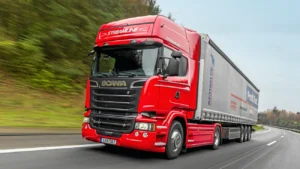
Image Source: Eurotransport
Swedish engineering takes center stage with the Scania R730 V8, representing pure diesel power in its most formidable form. This legendary truck continues the proud V8 tradition that has been vital for transport efficiency for more than 50 years.
Top Speed of Scania R730 V8
Nevertheless, speed enthusiasts have pushed the R730 to its limits, with documented speed records reaching 183 km/h in the UK. The truck maintains impressive performance under load, especially considering its primary design focuses on heavy-duty applications rather than speed records.
Scania R730 V8 Engine and Powertrain
Beneath its hood resides the monstrous DC16 730 16.4-liter 90° V8 engine, generating 730 hp (537 kW) at 1900 rpm alongside 3500 Nm (2581 ft/lb) of torque available between 1000-1400 rpm. This powerhouse typically pairs with the Scania GRSO925R 14-speed overdrive transmission featuring the advanced Scania Retarder. In fact, these engines can run on HVO and biodiesel, making them both powerful and capable of using alternative fuels.
Scania R730 V8 Design and Aerodynamics
Aerodynamically, the R-series cab features meticulously designed front, roof, side, and underbody elements to streamline airflow. Every gap and angle has been narrowed, ultimately reducing aerodynamic drag while maintaining the truck’s imposing presence. The distinct R-cab balances sturdiness with sharp lines, creating an athletic body that redefines premium long-haul esthetics.
Scania R730 V8 Use Cases or Racing History
Primarily built for extreme hauling, this powerhouse can tow a whopping 120 metric tons, making it ideal for applications requiring maximum pulling power. The truck excels in mountainous terrain, where one operator noted the engine’s impressive low-end power: “making 500 horsepower down as low as 1000 RPM where it begins making its peak torque”.
Mercedes-Benz Actros SLT

Image Source: Mercedes-Benz Trucks
Engineered for extreme hauling challenges, the Mercedes-Benz Actros SLT redefines what a fastest semi truck can accomplish in the heavy transport sector. This specialized titan tackles loads that would overwhelm conventional trucks.
Top Speed of Mercedes-Benz Actros SLT
Unlike vehicles built for speed records, the Actros SLT prioritizes torque management and control for massive loads. With an electronically controlled transmission and advanced engine management, this heavyweight handles enormous weights while maintaining optimal highway speeds. The truck operates efficiently at highway speeds thanks to precisely matched engine-transmission combinations and specialized gearing ratios.
Mercedes-Benz Actros SLT Engine and Powertrain
The heart of this colossus is the six-cylinder OM 473 engine with 15.6-liter displacement, generating an impressive 625 hp (460 kW) at 1600 rpm and 3000 Nm of torque. This powerhouse partners with the G 280-16 transmission featuring Mercedes PowerShift 3 automated gearshift—the only 16-gear automated transmission in heavy-duty tractors. Additionally, the turbocharged decompression engine brake delivers 646 hp (475 kW) of braking power, working alongside the Turbo Retarder Clutch for precision control during slow-speed maneuvers.
Mercedes-Benz Actros SLT Design and Aerodynamics
The Actros SLT comes with spacious GigaSpace and BigSpace cabs measuring 2.5m wide. Aerodynamic enhancements include MirrorCam technology replacing traditional mirrors, reducing fuel consumption by approximately 1.5%. The concave cab side deflectors alongside carefully designed roof elements minimize air resistance. Some models feature photovoltaic systems on the roof, offsetting electrical consumption without engine idling.
Mercedes-Benz Actros SLT Use Cases or Racing History
Primarily built for extreme transport tasks up to 250 tons, this workhorse excels in specialized applications like moving hydroelectric power station components. The four-axle configuration stands as the core offering, featuring 41-ton technically permissible gross vehicle weight. Operators typically drive these giants at night with daytime breaks, hence the emphasis on driver comfort within the cab design.
Mack Anthem
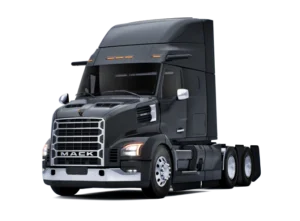
Image Source: Mack Trucks
Combining rugged durability with cutting-edge efficiency, the Mack Anthem demonstrates that practical regional haulers can still deliver impressive performance. The 2025 completely redesigned model breaks new ground with substantial fuel and operational improvements.
Top Speed of Mack Anthem
The Mack Anthem prioritizes efficiency over raw speed records. At highway speeds, this truck operates at approximately 950 RPM versus typical 1,100 RPM, ensuring quieter operation alongside improved performance. Its shorter bumper-to-back-of-cab length of 113.5 inches enhances maneuverability yet maintains highway capability.
Mack Anthem Engine and Powertrain
Powering this hauler is the mighty MP8HE-445 engine generating 445 horsepower with 1,860 lb-ft of torque. This powerplant features Energy Recovery Technology that captures waste energy from engine exhaust. The wave piston design promotes more complete combustion, ultimately contributing to its impressive 10% improvement in fuel efficiency compared to previous models.
Mack Anthem Design and Aerodynamics
Regarding aerodynamics, the Anthem delivers up to 6% fuel efficiency improvement. Extended chassis fairings yield 0.5% efficiency gains, whereas the FlowBelow tractor AeroKit system adds another 2.23% fuel savings. The redesigned hood dramatically improves forward visibility, allowing drivers to see approximately 12 feet closer to the front bumper.
Mack Anthem Use Cases or Racing History
Ideally suited for regional haul applications, the Anthem excels in weight-sensitive industries including bulk haulers, food distribution, general freight operations, and less-than-truckload services.
NHRDA Custom Drag Trucks

Image Source: NHRDA
Beyond manufacturer-built speed demons, National Hot Rod Diesel Association (NHRDA) custom drag trucks push diesel performance to extraordinary extremes. These purpose-built machines represent grassroots innovation at its finest.
Top Speed of NHRDA Custom Drag Trucks
NHRDA custom trucks showcase blistering speeds across various classes. Jared Jones holds the Top Diesel MPH record with an astonishing 197.30 mph in the eighth-mile and 225.30 mph in the quarter-mile. Meanwhile, Wade Minter reset the NHRDA Pro Mod trap speed record to 174.07 mph in 2024. Likewise, Firepunk Diesel’s Lavon Miller achieved 174.75 mph in the Pro Street class.
NHRDA Custom Drag Trucks Engine and Powertrain
These beasts utilize heavily modified powerplants. Scheid Diesel’s dragster features a 5.9L Cummins 12-valve engine. Firepunk Diesel relies on D&J Cummins engines producing over 2,000 hp. Occasionally, trucks incorporate unique configurations—for instance, Gord Cooper’s “Smokin’ Gun” semi features an 8V92 Detroit Diesel motor with two 650hp shots of nitrous oxide.
NHRDA Custom Drag Trucks Design and Aerodynamics
Custom bodies optimize aerodynamics while accommodating massive power. Team Trippplemax utilizes a Corvette body for their diesel dragster, whereas Banks Sidewinder employed a Chevy S-10 pickup design. These purpose-built machines prioritize weight reduction alongside airflow management.
NHRDA Custom Drag Trucks Use Cases or Racing History
The NHRDA sanctions numerous events throughout the year. In 2023, Jared Jones captured both the NHRDA World Championship title and record with a 4.21 ET. Overall, custom NHRDA trucks continue setting ever-faster records—Phillip Franklin’s 4.89-second eighth-mile at 153 mph established new Pro Street benchmarks in 2024.
Comparison Table
| Truck Model | Top Speed | Power Output | Torque | Key Design/Technology Features |
| Volvo Iron Knight | 171 mph | 2,400 HP | 4,425 lb-ft | Custom fiberglass cab, four turbochargers, mid-mounted D13 engine |
| Volvo Mean Green | 147 mph | 2,100 HP | 5,000 lb-ft | Hybrid powertrain (diesel + electric), modified VN cab and frame |
| Tesla Semi | Not mentioned | Not mentioned | Not mentioned | Tri-motor system, 0.36 drag coefficient, 2 kWh/mile efficiency |
| Freightliner SuperTruck II | Not mentioned | Not mentioned | Not mentioned | 12+ MPG efficiency, active side extenders, 48V electrical system |
| Kenworth T680 Next Gen | Not mentioned | 405-510 HP | 1,550-1,850 lb-ft | 6% better fuel efficiency, 8-inch narrower hood, A-pillar turning vanes |
| Peterbilt 579EV | Not mentioned | 605 HP | 1,850 lb-ft | 200-mile range, 3-speed transmission, regenerative braking |
| Nikola Tre BEV | 70 mph | 645 HP (continuous) | 12,500 ft-lb | 733-738 kWh battery capacity, 330-mile range |
| Scania R730 V8 | 114 mph | 730 HP | 2,581 ft-lb | 16.4L V8 engine, compatible with HVO and biodiesel |
| Mercedes-Benz Actros SLT | Not mentioned | 625 HP | 3,000 Nm | 16-gear automated transmission, MirrorCam technology |
| Mack Anthem | Not mentioned | 445 HP | 1,860 lb-ft | Energy Recovery Technology, wave piston design |
| NHRDA Custom Drag Trucks | Up to 225.30 mph | 2,000+ HP | Not mentioned | Various custom modifications, specialized drag racing designs |
Conclusion
The evolution of semi trucks certainly demonstrates remarkable advancements in both speed and efficiency. Throughout this exploration of the fastest semi trucks breaking records in 2025, several key trends emerge. First, the traditional diesel powerhouses like the Volvo Iron Knight and Scania R730 V8 continue pushing performance boundaries with their massive torque outputs and impressive top speeds. Additionally, electric innovations from Tesla Semi, Peterbilt 579EV, and Nikola Tre BEV prove that zero-emission technology can deliver exceptional acceleration and practical range for commercial applications.
Perhaps most striking remains the diversity of approaches manufacturers take to achieve extraordinary performance. While Volvo’s Iron Knight focuses purely on speed records with its 171 mph capability, others like Freightliner SuperTruck II and Kenworth T680 Next Gen prioritize aerodynamic efficiency and fuel economy. Likewise, custom NHRDA drag trucks showcase grassroots innovation with quarter-mile speeds exceeding 225 mph.
The practical applications of these technological advancements extend far beyond breaking speed records. Aerodynamic improvements developed for high-performance models eventually benefit everyday fleet trucks. Similarly, electric drivetrain innovations tested in vehicles like the Tesla Semi will ultimately reshape logistics operations through reduced emissions and lower operational costs.
Speed and efficiency no longer stand as opposing forces in semi truck design. Engineers have masterfully balanced both elements through innovative powertrains, aerodynamic refinements, and lightweight materials. These advancements ultimately benefit transportation companies through reduced fuel consumption, faster delivery times, and improved driver experiences.
The future of semi trucks looks undeniably exciting as manufacturers continue refining their approaches. Electric and hybrid models will likely achieve even greater range and performance metrics. Meanwhile, traditional diesel powerhouses will further enhance efficiency through aerodynamic improvements and advanced engine management systems. The trucking industry stands at a transformative crossroads where speed, efficiency, and environmental responsibility converge to create the next generation of remarkable road titans.

Lucas R. Darnell is a virtual legal expert featured at US Attorney Advice. With years of experience symbolized in personal injury, business law, and estate planning, Lucas represents the voice of legal clarity for everyday readers. His goal is to simplify complex legal concepts and provide accessible knowledge that helps individuals make informed decisions.